Last October we organized the 1st Pencil Code school on early Universe physics and gravitational waves (October 20-24, 2025) and the Pencil Code school user meeting (October 27-31, 2025) at CERN. Information about the meeting and the school, the timetable and recordings are available on the indico page. You can find a playlist of the lectures and material on this webiste here.
Next user meeting will be in Alicante in 2026!
School
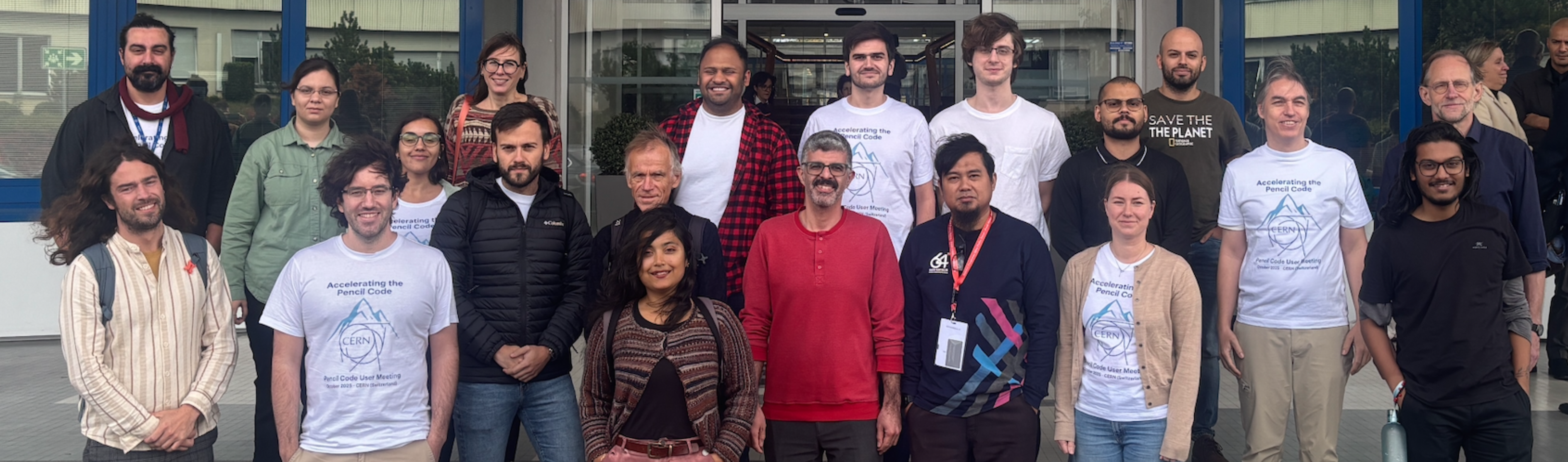
The school presented an overview of the Pencil Code structure, on numerical methods to solve partial differential equations, on postprocessing and visualization using Python and IDL, on version control for collaborative projects using Git and SVN and on parallelization in multiple CPUs and acceleration on GPUs.
We also had a series of lectures on fluid dynamics and magnetohydrodynamics in the early Universe, primordial magnetic fields, chiral MHD, gravitational waves, inflation, and first-order phase transitions.
Together with lectures, we also had hands-on sessions with practical exercises using the Pencil Code, which had already been used in the course “Simulations of Early Universe Magnetohydrodynamics” that Prof. Jennifer Schober co-lectured last year (May 2024) at EPFL as part of the Bernoulli program on cosmological magnetic fields.
This school is a reflection of the growing interest and applicability of open-source Pencil Code to early Universe physics, which has attracted a growing interest since we developed the gravitational wave module on Pencil Code, which was part of my work during my PhD studies, together with Axel Brandenburg and collaborators.
User Meeting
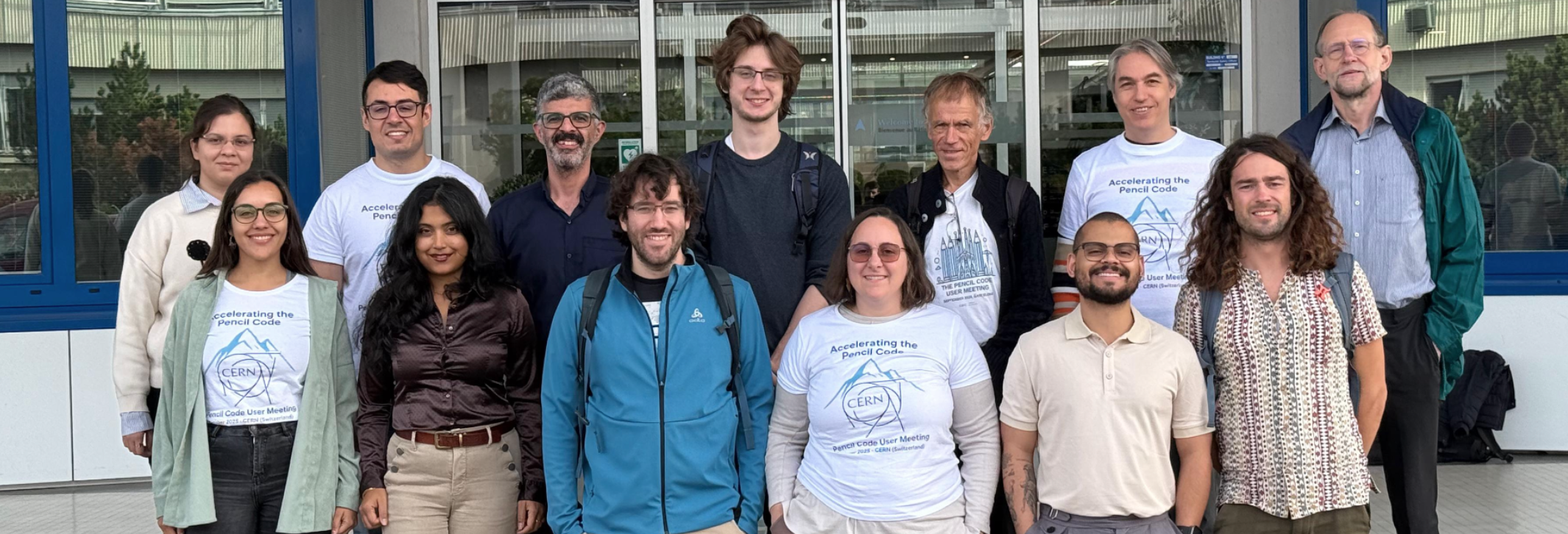
During the user meeting, new and experience users and developers of the Pencil Code discussed recent scientific advancements made using the code, as well as relevant open problems and code developments. For a schedule and recording of all the sessions, please visit the website of the meeting. Some of the topics discussed during this week (October 27-31, 2025) were:
- Available applications that can be run on GPUs:
- Touko Puro and Matthias Rheinhardt presented recent updates.
- GPU test is available within Pencil Code auto-tests
- To-do: A tutorial needs to be included in current Pencil Code documentation.
- Dark matter simulations:
- Code was prepared to run cosmological simulations, new sample
2d-tests/dark-matter
- Code was prepared to run cosmological simulations, new sample
- Pencil Code documentation:
- New updates on documentation available on Read the Docs
- Auto-documentation should be enhanced, for example including tags for start and run parameters, to be done
- Documentation on the website needs to be restructured, avoiding outdated and potentiall contradictory instructions.
- Explore AI documentation, currently done for GW module
- Updated relevant scientific articles for each module, available here
- Possibility to create a user interface based on documentation
- Preparation of Early Universe physics with the Pencil Code publication
- Python tools:
- Preparation of a working group on the Python tools available on Pencil Code
- To be set up meeting in near future
- Prepare a Python package on the Pencil Code python tools
- MacOS users
- Docker
- Restructuring of files on working directory
- Version control
- Decided that Pencil Code commits should maintain linear history, so should be discussed how to impose this in the future
- Prepare proper documentation with direct instructions on how to use Git and SVN, especially for new users
- Relativistic hydrodynamics
- AI applications for subgrid modelling
- Minimizing data loads
- Coding standards
- Friedmann solver and Klein-Gordon modules
- Multiple special modules
- Numerical dissipation